Things That You Should Buy If You Are Training Your Child To Sleep Independently

Sleep is the most important factor in a child’s growth. Poor sleeping habits are linked with obesity and other health problems like depression and anxiety.

If you want your baby to grow healthier and happier, it is important that they sleep peacefully. Once your baby graduates to a toddler stage, you should start training them to sleep independently, but this cannot happen overnight. You have to gradually prepare the child to get into the habit of sleeping independently.

Here is a list of things you should buy if you are training your child to sleep independently:

1. Baby cot: The first step toward training your child is to have a separate baby cot for them. You can place the baby cot right next to your bed so that the kid gets used to sleeping separately but is within a safe reach. Gradually, when your baby is comfortable, you can put them in a separate room. Baby cots are expensive, so keep the following factors in mind before finalizing the cot:

• Safety: The structure of the baby cot should be such that your baby enjoys their bed and play time. The cot should be deep enough and bars should be perfectly distanced to prevent any slippage of the baby from the bed.
Convertibility: Buying a baby cot is a crucial decision as it involves huge investment. Ensure that it can be converted to a baby bed as your baby grows.
• Adjustable height: Your baby grows faster than you think. Ensure that the height of the baby cot is adjustable with the growth of your child.
• Durability: A baby cot is a one-time investment; ensure it is sturdy and durable.

2. Cot bumper: Transition from a big bed to a baby cot can be uneasy for the baby. You do not want them to get hurt in their new bed. This is when cot bumpers come handy. Buy a cot bumper that is airy and does not suffocate the baby by blocking fresh air.

3. Baby monitor: Once your baby is comfortable in their own room, a baby monitor can help you listen to or keep a watch on them from another room. You can either choose a visual baby monitor or go for a simple audio monitor.

Keeping your baby safe while they are sleeping is very important, so buy items which can help your baby and you sleep peacefully and independently.

Stranger Anxiety In Children

Babies are the most innocent creatures and they enjoy the company of anyone who plays with them or entertains them. By the 6th to 9th month, babies start recognizing people around them. And once they learn that, their behavior towards anybody other than their parents can markedly change. Members of family, other than parents, also come under the category of strangers for the baby. This phenomenon is known as “Stranger Anxiety.”

Stranger anxiety is a natural and normal phenomenon in kids. It ensures that your kid has a survival instinct inherent to all human beings.

Kids with stranger anxiety may also show preference for one parent over another. Parents should be careful while dealing with this behavior of the kid. Here are a few tips to show how you should handle this phase of your childʼs growth:

1. Reassure your child: A bubbly child can suddenly become upset, scared, or quiet on arrival of family or friends. Reassure your child that everything is okay and you are there with them. Reassurance boosts their confidence and helps them recognize family or known members.

2. Stay close: When stranger anxiety hits your child, stay close to your baby. This is necessary to make your baby feel that they are “safe” with you and you will not let anyone hurt them. Also, do not force your kid to mingle with guests. Let them take their time to open up.

3. Make your kid comfortable: Do not leave your anxious tot with the guests till the time they are comfortable. You can plan games or fun activities to break the ice. If your child is constantly unhappy or upset to see a particular relative or friend, be watchful of the guest’s behavior.

4. Coach the guest: You may have a distant relative who has especially come down to meet your nipper and may get upset with your baby’s anxious behavior. Explain the relative or friend about this phase and ask them to slowly and gradually mingle with the baby.

5. Do not scold: This phase can be irritating at times, but do not scold your baby; instead assure and reassure your child. By scolding your baby, you may cause an irreversible damage to their behavioral patterns. This will also prevent your child to divulge any mistreatment by a strangers.

Each and every phase of your child is very important for their development, and as a parent you should be careful to nurture all aspects of their development.

Safety Features To Look For Before Buying A Car Seat

A car seat is synonymous with your child’s safety on roads. We do not mind paying an extra penny when it comes to the safety of your child. But are you sure that extra penny was worth the feature? Most of the new parents face a problem while buying a car seat for their newborn. They trust the shopkeeper and end up paying for features which are of no or less use.

To help you make a better decision and not repent later, here are the safety features you should look at before buying a car seat:

1. Harness: Your baby’s safety lies in the harness of the car seat as it is the one which prevents your child bearing the brunt of shock. Therefore, one of the major safety features to look for is to always ask for a five-point harness system. Also, the harness should have adjustable length so that your kid can fit in for a longer period.

2. Headrest: Headrest and neck pillow are another important feature as they provide cushion to your baby’s neck and secure their head and spine. They prevent any sudden jerks to the brain or neck. Many kids suffer from shaken baby syndrome in a car accident. This may lead to brain swelling, seizures, and even paralysis. So ensure that your car seat has a good cushioned headrest and neck pillow.

3. Chest pads: You must be thinking that a harness is enough to hold back your baby. Definitely, the harness will not allow the kid to fall off the car seat, but to avoid lurching forward, chest pads are necessary. The impact protection shield of a chest pad diffuses the shock/forces during any accident and protects the baby from any injury caused by sudden strain on the chest.

4. Latch: You cannot just place the car seat in the rear without securing it to any of the strong points. The car seat can slide from one end to another and may even crash in the front seat in case of an accident or sudden brakes. To avoid this free movement of the car seat, check for the latch system. Always make sure that the car seat is properly hooked to the car seat before you travel with your baby.

There are numerous features in a car seat, but the ones mentioned here are the most important. Buy a car seat which is not only safe but also comfortable for your kid.

Rear Facing Car Seat Its Advantages And Age Suitability

Car seat is hands down a necessary travel accessory when you are travelling with your baby. Depending on your need, you can choose from a wide range of car seats available in the market. They are of two types: front facing and rear facing.

Front facing seat, as the name suggests, is the one where the child faces in your direction while you sit on the front seat of the car. In a rear-facing car seat, your child sits in the direction opposite to yours.

Both types of car seats have their own advantages. If you are a new parent, then we suggest that you opt for a rear-facing car seat till your child turns four. This may sound strange to many, but here are the advantages of buying a rear-facing car seat:

1. Frontal crash: Your babyʼs head, neck, and spinal cord are the ones which are the most vulnerable to damage in a frontal crash. A rear-facing car seat cradles the baby’s head, neck, spine, and torso and disseminates the crash forces to the seat, thus preventing any shock injury to the child.

2. Safer legs: During a crash, your child’s legs can be compressed by the front seat. But if your child is sitting in a rear-facing car seat, the legs are in a cannon-ball position. No matter how bad the crash is, your child’s legs will suffer from no major injuries and therefore will always be safe from any kind of accident or shock.

3. Enjoy the view: While you travel with your child, their entertainment is very important to contain them in the car seat. Apart from talking, singing, and telling stories, you can keep them busy with the outer view. Kids can enjoy uninterrupted view of the outside while on the go.

Therefore, ideally you should use a rear-facing car seat till your baby turns four. However, determining the right age can be a debatable issue for many parents and most will switch to a front-facing car seat after their child’s second or third birthday. Whenever you choose to switch the car seat, make sure that the transition is smooth. Buy a safe and comfortable car seat to enjoy your travel with the child and ensure that your child is safe from any untoward incident.

Co-Sleeping vs Independent Sleeping

When a child is born, they follows their own sleeping cycle. However, as they grow up, they gradually start following the natural sleep cycle. Today, we are not debating on how well your baby sleeps at night, but “Where does your baby sleep at night?”

To help you make a better decision as where to place the expensive baby cot you bought, we have penned down the pros and cons of both co-sleeping and independent sleeping:

Co-sleeping

Co-sleeping, as the name suggests, is when the baby sleeps with the parents either on the same bed or in the same room on a baby cot or baby bed.

Pros

1. More sleep: The mother can easily nurse her baby at night without disrupting the baby’s sleep.
2. Better bonding: You can spend more quality time with your baby without any distraction, resulting in a better family bond.
3. Faster soothing: It is easier and quicker to sooth a co-sleeping baby at night than when they are in a different room.
4. Reduced risk of sudden infant death syndrome (SIDS): Studies have shown that babies who co-sleep with their parents have a reduced risk of SIDS.

Cons

1. Tiring for parents: Co-sleeping parents may wake up tired the next morning owing to nursing and attending the baby the entire night.
2. No privacy for parents: Bed time is the only time when parents can have quality time with each other. Co-sleeping with kids can take away this privilege of intimacy.
3. Dependent baby: Co-sleeping babies are more dependent on parents as they become habitual to getting nursed on waking up at nights.

Independent sleeping

Independent sleeping is not just sleeping in the baby cot, but sleeping in a baby cot or baby bed in a separate room.

Pros

1. Independent: Kids who sleep in their own room are more independent than co-sleeping children.
2. Parent’s personal time: Individual sleeping enables parents to have quality time with each other.
3. Quick nap: Since there are lesser distractions as compared to co-sleeping, the baby falls off to sleep quickly as compared to co-sleeping.

Cons

1. Nursing: Nursing or soothing a kid is inconvenient for both the baby and the parent if the kid is not co-sleeping.
2. Less bonding: Nowadays both the parents are working, and if they are not co-sleeping with the baby, the family bonding has to be done well before bedtime.

We hope this information would help you make a wise decision. Whatever your take is on baby sleeping, one thing we would like to suggest is to invest in a good baby cot which has adequate safety features to prevent any untoward incident while your baby sleeps comfortably.

Car Seat Its Advantages

A car seat is one of the items that should be in your bucket list when you begin to shop for your newborn. Even if you are not planning for a long or adventurous road trip, a car seat is a necessary travel accessory.

Ideally, kids below 3 years should be buckled up in a car seat. Since most of the parents find a car seat unimportant or extra baggage, we list a few advantages of a car seat which will break the myth around them.

1. Child safety: Parents are restrained by seat belts, which can save them in case of accidents. On non-availability of a car seat, children are mostly in the lap of their parents or in the rear seat without child safety. A car seat will not only safeguard the child in case of an accident but also when sudden brakes are applied.

In case of any accidents, children are most prone to injuries. A survey report states that car seats can reduce child injury and death by 71% and 28%, respectively.

2. Convertible baby carrier basket: If you are going out and your baby sleeps in the car, you do not have to worry about waking the kid while moving out of the car. You simply have to uninstall the car seat and take it along with you while your baby sleeps comfortably.

3. Comfort: You do not want to compromise on the comfort of your kid. The rear seat of the car is huge for the child. You do not want the kid to slide through the seat with every turn. A car seat can solve this problem. The child can snuggle in the car seat and enjoy the family ride. Trust us; a happy and comfortable kid is lot easier to handle.

4. Assurance for parents: Parents are always worried for the safety of their child. Even if the kid is in the co-pilot’s lap, there is apprehension among parents regarding the safety of their child. A car seat frees parents from all such worries and enables both the parents and the kid to enjoy their ride. With this assurance, the parent can concentrate on their driving.

The safety of your kid is a priority for every parent. A car seat is one of the travel accessories which can ensure safety of your child in any vehicle. Reason enough to buy one today, isn’t it?.

Baby Safety Essential For Travel Car Seat

Travelling with an infant for the first time can be a taxing job and planning a trip can be all the more overwhelming.

So before you set on a trip, go through your checklist several times to ensure that travel with your baby is as comfortable and safe as you expect. To help new parents have a hassle-free trip, here are some essentials that you must include in your checklist:

1. Diapers: You do not want your baby to stay wet or dirty, so always pack few extra diapers.
2. Changing mat: You cannot ensure the hygiene of your home to be ubiquitous. Therefore, always carry a changing mat to ensure that your baby is insulated from unhygienic surfaces.
3. Blankets: Small children are very vulnerable to temperature variations. Carrying a blanket is the best option to prevent your child from feeling cold. Blankets can also be used while you nurse your baby or for providing shade to your little charmer.
4. Trash bags: A trash bag comes handy to dispose diapers and store soiled clothes.
5. Wipes: There may be times when you do not have washrooms to change your baby’s diaper. With wet wipes you can clean the baby on the go.
6. Extra clothes: It is always safe to carry 2–3 extra pairs of clothes while travelling with your baby.
7. Car seat: This is the most essential item on your list if you are travelling in your own car. This will ensure your child’s safety at all times.

Car Seat: A travel essential

The child’s safety is paramount for every parent. A car seat is the first and the most crucial step toward protecting your child from any accident. The benefits of a car seat are listed below:

1. The 5-point harness system buckles the baby and prevents from any shock.
2. The headrest and neck pillow secure the head, neck, and spine. They safeguards the child from rapid jerks.
3. The chest pads diffuse any unfortunate accident shock and save the kid from sudden pressure on the chest.
4. The latch of the car seat ensures that the seat does not slide across the car and is secured to a strong point.
5. Some car seats can also be converted to a baby carrier or basket.

So, investing in a good, safe, and comfortable car seat is a must.

Baby Crawling Things To Ensure At Home For Safety

To see your baby crawl is full of mixed emotions. You feel elated to see the first independent movement of your child, but then the next moment you become scared about his/her safety. To ensure that your baby is safe from sharp or hazardous items, you have to baby-proof your home.

Here are top things to ensure at home for the safety of your baby:

1. Crawl like a baby: To ensure that you have perfectly child-proofed your home, you have to be at your baby’s level/height. So crawl round the room to double check about the sharp edges of the furniture and other things kept at your home.

2. Toilet paper roll rule: Babies follow a simple rule “Any and every thing you see, put it in your mouth.” To prevent your baby from getting choked, take a toilet paper roll cardboard. Anything that can fit in the roll must be kept out of your childʼs reach.

3. Switch boards: We do not know why but switch boards attract babies. Since most of us have our switch boards near the floor, baby proofing them is a must. Also, cover the wires to avoid tripping hazards and accidental electric shocks.

4. Latches: When your child crawls, they try to open drawers and cabinets within their reach. You should install latches to cabinets and drawers to ensure any hazardous or sharp items like knives or bathroom or floor cleaners are out of their reach. To be on a safe side, put a latch on all the cabinets that are within your child’s access.

5. Stair Gate: Stairs are something which your child finds the most amusing. Ensure you protect your nipper from this danger zone. Install gates with proper lock at the entrance of staircases. Let your child explore the staircase once he/she is big enough to climb it.

6. Door Jammer: Install door guards in all areas accessible to your child. You definitely do not want your baby to squeeze his/her fingers in a closing door. Also, it ensures your baby does not get locked in a room.

7. Say “NO”: No is a very powerful word. Kids usually learn to say “No” first. Warn them about various hazards and tell them not to touch or do anything that might harm them.

There is no perfect way to baby-proof your home. Apart from the above tips, monitor your kid carefully and accordingly child-proof your home.

Breastfeeding: 5 Things That Every Mother Starting At Breastfeeding Should Know

All thanks to the Internet and electronic media, we all are well aware of the importance of breastfeeding and the benefits of breast milk. But is it all the information you need? We want that you should be fully aware and prepared before your munchkin arrives in this world. So tighten your seat belt as we will unfold five breastfeeding basics that every mother wishes to know before she starts feeding her baby.

1. Early skin-to-skin contact

Have a skin-to-skin contact with your baby as early as possible. It is a great way to bond and welcome your kid to the new world. If possible breastfeed the baby in the delivery room itself. Your breast will produce a golden yellow color liquid in the first few days, which is known as colostrums. This is the healthiest food that can boost the immunity of your baby.

2. Frequency of feeds in a day

It is a common question among the new mothers as to the number of times a day your baby needs to be breastfed. When your baby is born, their tummy is very small and would require to be fed every few hours. It is advisable that in the first month, infants should be fed every 2 hours. Slowly and gradually their stomach size increases and the breastfeeding frequency becomes less. After the first month, feeding can be “on demand.”

3. Latching baby onto the breast

A good latch is another problem faced by the new moms. It takes a few hit and trails before finding the right position. Improper latching can lead to breast discomfort. Make sure that the areola and nipple both are in the baby’s mouth while he/she drinks milk. If you encounter any discomfort, detach your newborn and try again for a proper latch.

4. Signs of hunger

As already mentioned, after the first month, feeding should be on demand. You do not have to wait until tears roll down your baby’s cheeks. Although babies cannot speak, they can very well communicate their needs. All you need to understand are the tiny signals your baby is giving. They snuggle around your breast and suck their fingers; rooting reflex is also a sign of hunger.

5. Breastfeeding positions

Breastfeeding can take more time than you expect, so you should be comfortable while your baby is having their meal. Find a cozy and quiet place where you can nurse your child. Cuddle your baby and support their back and head with your arm. Few mothers find a nursing pillow or footstool helpful in supporting the baby. There are various positions to breastfeed, but you can choose the one that is comfortable for you and your baby.

Breastfeeding may not be a cake walk, at least in the initial days, as you see in ads or photographs. Nursing for the first time can be difficult for new mothers, so do not hesitate and take help from a midwife, doctor, or lactation consultants. Just remember, a mother’s milk is an elixir for a newborn that keeps your baby in excellent health.

Colic: Symptoms And Home Remedies

So you finally came home with your little one. Just before you were setting your routine according to your baby’s sleep cycle, a new chapter unfolds in your baby’s life. Your baby starts to cry uncontrollably and you are unable to help him/her. This mysterious phase is known as colic.

What is colic?

You baby is suffering from colic if he/she is healthy but cries for more than three hours a day and for more than three days a week. Only 40% of the children are affected by infantile colic. It usually begins at 2-3 months and goes away when you child is 6 months old. Although the reason for colic cries is still uncertain, doctors state some of the probable reasons as gas in the tummy, over-stimulated senses, immature digestive system, and food allergies.

Symptoms

Colic cries are different from normal crying. In colic, crying sessions are intense and usually accompanied with screaming. Babies will clench their fist, press the knees close to their tummy, and arch their back. They appear to be in distress and may even pass gas. These testing times can be frustrating for parents. Maintain your cool and help your baby to calm down. Remember not all cries are colic, so to rule out any medical problem, consult your pediatrician. Ensure your baby is not irritated due to an infection, eye or ear trouble, irregular heartbeat, or injury.

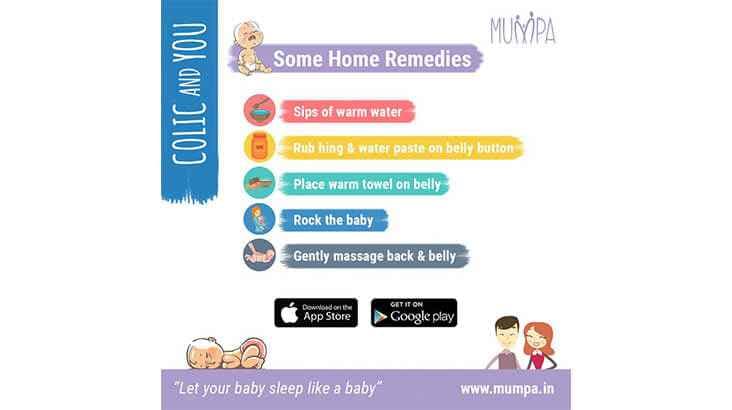
Home remedies

When your baby is colic due to digestive issues, you can give them gas drops, probiotics drops, or gripe water. But what if the pain still continues? Putting your tot on any medication should be your last resort. These are few time-tested home remedies that can relieve your little one from the colic pain.

1. Mustard oil massage: Massage your baby with mustard oil followed by a warm water bath. This will help the baby get rid of gas problem and colic pain. It will improve blood circulation and relax the body movements. It also helps in inducing sleepiness in your baby.

2. Warm water: Give lukewarm water to your baby. It will bring out the stomach heat. You can even give cumin water once a day. Ensure to make the baby burp after he/she drinks water and milk.

3. Asafetida: Add asafetida in warm water and rub on your baby’s tummy and navel area. This is also an effective way to get rid of gas problems.

4. Fresh air: Going outdoors can magically uplift your baby’s mood. The chirping of birds, sound of winds, and brightness of the sun can distract the baby and comfort him/her.

5. Car ride: Trust us, one car ride can do wonders. This technique has 95% success rate. Colicky babies calm down quickly and even fall asleep in a car ride. If your baby gets cranky at midnights, this is one method you have to try.

Colicky kids are hard to handle. Getting frustrated is pretty normal. Give yourself a break; take help from family members and friends. Do not be guilty; colic has nothing to do with you. You are doing great to soothe your cutie pie and this shall pass. “There is no such thing as a perfect parent. Be a real one.” Happy Parenting!